
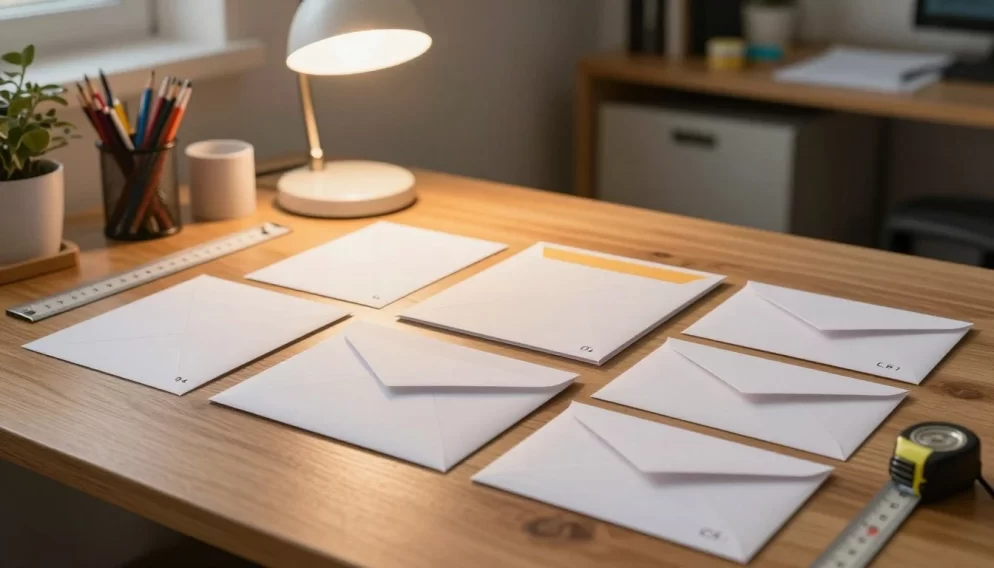
Choosing the right paper size for envelope printing can be tricky. Many find it hard to pick the correct size for their mail. The wrong choice can lead to printing mistakes, wasted materials, and late mail.
Knowing what paper size you need is key to professional results. Your choice impacts how your mail looks and if it meets postal rules. Getting it right saves time, money, and stress.
This guide covers everything about envelope printing sizes. You’ll learn about common sizes in America. You’ll also find out how to match paper sizes to your project. Whether it’s for business or personal mail, this guide has you covered.
This info is for both beginners and pros who need quick tips. You’ll see why the right envelope size is crucial for your mail. And how to avoid mistakes that cost you money.
Key Takeaways
- Standard envelope sizes range from small announcement envelopes to large catalog envelopes used for business mailings
- Paper dimensions must match your envelope type to ensure proper printing and postal compliance
- Common sizes include number 10 envelopes for business letters and number 6 envelopes for greeting cards
- Converting between inches and centimeters helps when working with international printing specifications
- Choosing the correct envelope sizes for your purpose prevents costly reprinting and delays
- Postal regulations require specific envelope dimensions for mail to be processed correctly
- Professional appearance depends on selecting appropriate paper size for envelope printing that matches your brand
Understanding Envelope Printing Basics
Getting your envelope printing right starts with understanding the basics. There are many envelope sizes for printing, and picking the right one is key for your mailing success. The United States Postal Service (USPS) has clear guidelines for standard mail. These guidelines affect postage costs and delivery speed.
Learning these basics helps you avoid costly mistakes. It keeps your mail moving smoothly through the postal system.
Why Envelope Size Matters for Your Mailing Needs
Choosing the right envelope size impacts your mailing costs and delivery time. The USPS charges different postage rates based on envelope dimensions. Mail that doesn’t meet standard sizes is more expensive.
Envelopes that are too small may not hold your documents safely. Those that are too big are a waste of money.
Envelope sizes also affect how your mail is processed. Modern postal facilities use machines that sort mail by size. When your envelope meets standard sizes, it’s processed quickly. This means faster delivery to your recipients.
Professional appearance is also important. The right size envelope keeps your contents safe during transit. It also looks polished for business or personal invitations.
Common Envelope Printing Mistakes to Avoid
Many people overlook important details when planning envelope projects. Knowing these common errors helps protect your investment:
- Using paper too thick for your printer, causing jams and delays
- Ignoring printer margins, which cut off important design elements
- Selecting envelope sizes for printing that don’t accommodate folded documents
- Neglecting USPS aspect ratio rules, triggering manual processing fees
- Choosing glossy finishes that smudge ink and look unprofessional
- Skipping test prints before ordering large quantities
Testing your design on sample envelopes before production prevents wasted materials. Following USPS guidelines from the start saves money and frustration. Taking time to verify envelope sizes ensures your mailing project succeeds.
Standard Envelope Sizes for Printing
When planning an envelope printing project, knowing the standard sizes is key. The U.S. uses a simple system for envelope sizes, making ordering and printing easy. This knowledge helps avoid mistakes and ensures your materials fit right.
There are two main types of envelopes in America: commercial and announcement envelopes. Commercial ones are great for business letters and documents. Announcement envelopes are best for invitations, cards, and special events. Each type has its own size and use.
The #10 envelope is the top choice for business mail in the U.S. It’s 4-1/8 inches by 9-1/2 inches and holds a folded 8.5 by 11 inch letter. Most companies use it for invoices, bills, and official letters.
Common Standard Envelope Sizes
- #9 Envelope: 3-7/8 inches by 8-7/8 inches, used for replies and smaller documents
- #6-3/4 Envelope: 3-5/8 inches by 6-1/2 inches, popular for personal notes
- A7 Envelope: 5-1/4 inches by 7-1/4 inches, ideal for greeting cards and invitations
- A6 Envelope: 4-3/4 inches by 6-1/2 inches, perfect for small cards and announcements
- 6 by 9 Envelope: 6 inches by 9 inches, excellent for brochures and catalogs
- 9 by 12 Envelope: 9 inches by 12 inches, used for documents that should not fold
Commercial envelopes have the flap on the long side, ideal for mailing. Booklet envelopes have the flap on the short side, best for flat documents like catalogs.
| Envelope Type | Dimensions (inches) | Best Uses | Paper Size Fit |
|---|---|---|---|
| #10 Commercial | 4-1/8 × 9-1/2 | Business letters and invoices | 8.5 × 11 (folded thirds) |
| #9 Commercial | 3-7/8 × 8-7/8 | Reply envelopes and smaller mail | 8.5 × 11 (folded quarters) |
| A7 Announcement | 5-1/4 × 7-1/4 | Greeting cards and invitations | 5 × 7 (flat) |
| 6 × 9 Booklet | 6 × 9 | Catalogs and brochures | 6 × 9 (flat) |
| 9 × 12 Catalog | 9 × 12 | Unfolded documents and photos | 9 × 12 (flat) |
Knowing these envelope sizes is crucial for a successful printing project. Each size has been tested and proven reliable for specific needs. Whether you need envelopes for business or special occasions, these sizes help you choose the right one.
What Paper Size for Envelope Printing?
Choosing the right paper size for envelope printing is key. It ensures your documents fit well inside the envelope. Most people print on standard letter paper and then fold it to fit their envelope choice. This way, your message arrives looking professional and intact.
Knowing the right paper size for envelope printing in inches helps avoid mistakes. Different envelope styles need different paper sizes. Getting this match right makes your mailings look polished and arrive safely.
Matching Paper Dimensions to Envelope Types
Standard letter paper is 8.5 inches by 11 inches. This size folds in different ways to fit various envelopes. Folding letter paper into thirds fits perfectly inside a #10 envelope, the most popular business envelope size.
Folding your 8.5″ x 11″ paper in half fits a 6″ x 9″ booklet envelope. For larger materials, a 9″ x 12″ catalog envelope is best. International A4 paper, measuring 8.27″ x 11.69″, needs slightly different envelopes.
Smaller paper formats also have matching envelopes:
- A5 paper (5.83″ x 8.27″) fits into A5 envelopes
- A6 paper (4.13″ x 5.83″) works with A6 announcement envelopes
- A7 paper (2.91″ x 4.13″) pairs with A7 small envelopes
Always leave at least 1/4 inch of clearance between your paper and the envelope interior. This space ensures smooth insertion and maintains a professional appearance.
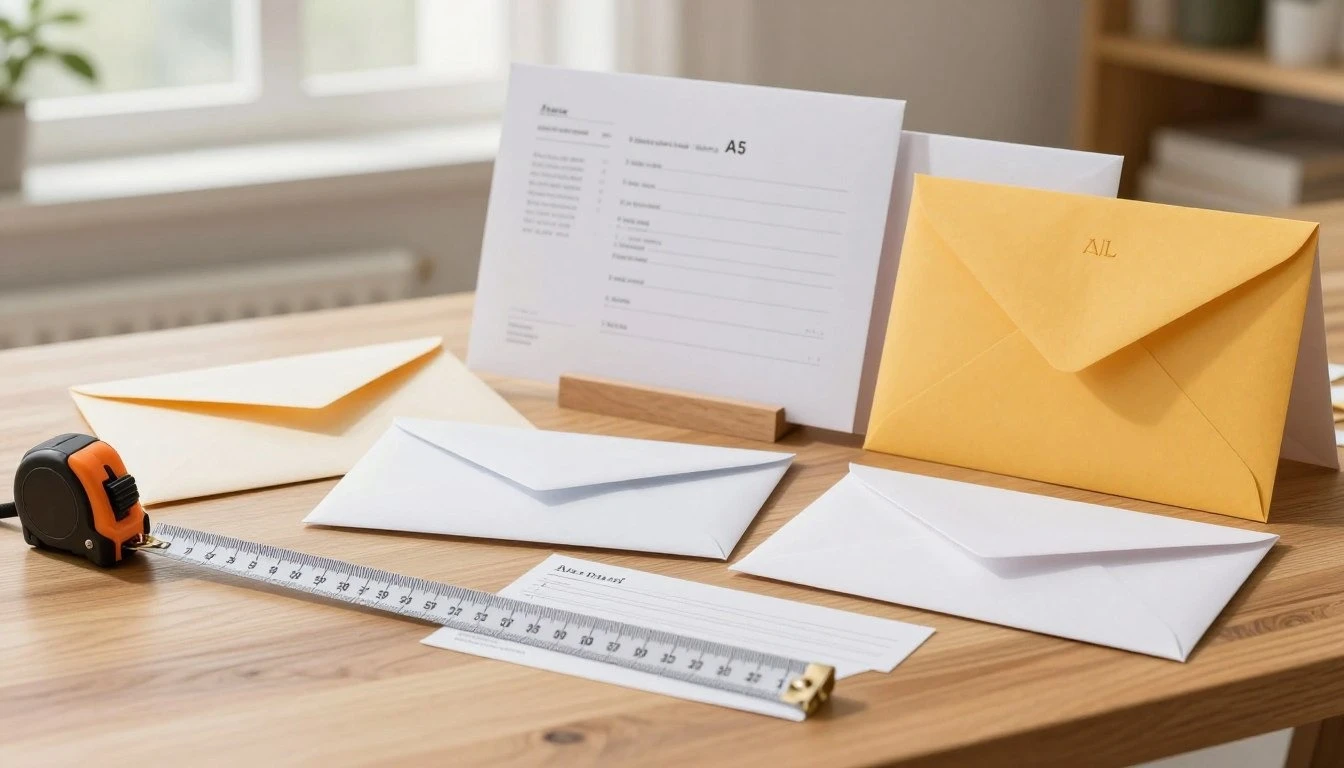
Converting Between Inches and Centimeters for Envelope Printing
Understanding paper size for envelope printing in cm is useful for international work. The conversion is simple: one inch equals 2.54 centimeters.
Here are common envelope sizes in both measurement systems:
| Envelope Type | Size in Inches | Size in Centimeters | Best Paper Match |
|---|---|---|---|
| #10 Business | 4.125″ x 9.5″ | 10.5 cm x 24.1 cm | Letter (8.5″ x 11″) folded |
| #9 Business | 3.875″ x 8.875″ | 9.8 cm x 22.5 cm | Half letter size |
| 6×9 Booklet | 6″ x 9″ | 15.2 cm x 22.9 cm | Letter folded in half |
| 9×12 Catalog | 9″ x 12″ | 22.9 cm x 30.5 cm | Unfolded letter |
| A7 Announcement | 5.125″ x 7.25″ | 13.3 cm x 18.4 cm | A7 paper size |
| A6 Invitation | 4.75″ x 6.5″ | 12.1 cm x 16.5 cm | A6 paper size |
Knowing both measurement systems is important. International printing companies often list specs in centimeters. Your design software might use different units. Printing equipment specs can be in either system.
Whether you work in inches or centimeters, accurate measurements prevent printing errors. They ensure professional results every time.
Popular Envelope Sizes in Inches and Centimeters
Knowing the standard envelope size in inches and centimeters is key for choosing the right one for your mail. In the U.S., businesses use several sizes for everyday and special mail. This guide shows the most common sizes for your envelope printing needs.
Business envelopes are crucial for professional communication. The #10 Commercial envelope is 4.125 inches by 9.5 inches, or 10.48 cm by 24.13 cm. It’s great for letters and business documents. The #9 Reply envelope is 3.875 inches by 8.875 inches, or 9.84 cm by 22.54 cm. The #6-3/4 envelope is smaller, at 3.625 inches by 6.5 inches, or 9.21 cm by 16.51 cm.
Announcement envelopes are used for personal and event mailings. Here are some popular sizes:
- A2 envelopes: 4.375 inches by 5.75 inches, or 11.11 cm by 14.60 cm – perfect for RSVP cards
- A6 envelopes: 4.75 inches by 6.5 inches, or 12.07 cm by 16.51 cm – ideal for greeting cards
- A7 envelopes: 5.25 inches by 7.25 inches, or 13.34 cm by 18.42 cm – fits 5″ by 7″ invitation cards
- A9 envelopes: 5.75 inches by 8.75 inches, or 14.61 cm by 22.23 cm – excellent for announcements
Catalog and booklet envelopes are for larger materials. A 6 inch by 9 inch envelope, or 15.24 cm by 22.86 cm, is good for marketing. Larger sizes include 9 inch by 12 inch, or 22.86 cm by 30.48 cm, and 10 inch by 13 inch, or 25.4 cm by 33.02 cm. These sizes keep documents flat and protected.
| Envelope Type | Size in Inches | Size in Centimeters | Best Used For |
|---|---|---|---|
| #10 Commercial | 4.125″ x 9.5″ | 10.48 cm x 24.13 cm | Business letters |
| #9 Reply | 3.875″ x 8.875″ | 9.84 cm x 22.54 cm | Reply envelopes |
| #6-3/4 | 3.625″ x 6.5″ | 9.21 cm x 16.51 cm | Small documents |
| A2 | 4.375″ x 5.75″ | 11.11 cm x 14.60 cm | RSVP cards |
| A6 | 4.75″ x 6.5″ | 12.07 cm x 16.51 cm | Greeting cards |
| A7 | 5.25″ x 7.25″ | 13.34 cm x 18.42 cm | Invitation cards |
| A9 | 5.75″ x 8.75″ | 14.61 cm x 22.23 cm | Announcements |
| 6×9 Catalog | 6″ x 9″ | 15.24 cm x 22.86 cm | Marketing materials |
| 9×12 Catalog | 9″ x 12″ | 22.86 cm x 30.48 cm | Certificates and documents |
| 10×13 Catalog | 10″ x 13″ | 25.4 cm x 33.02 cm | Large documents |
Specialty envelopes add unique appeal to projects. Square envelopes are great for wedding invites but need extra postage. European-style envelopes have pointed flaps for elegance. Window envelopes show addresses through, saving printing time. Knowing both standard sizes in cm and inches ensures your project meets your needs.
Choosing the Right Envelope Size for Different Purposes
Choosing the right envelope size is key for your mailing needs. Each situation requires a specific size. Whether it’s for business or personal use, knowing the right sizes ensures your mail looks good and gets there safely. This guide helps you pick the best size for your needs.
Business Correspondence and Professional Mailings
The #10 envelope is the top choice for business mail in the U.S. It’s 4.125 inches by 9.5 inches, perfect for a standard letter. It’s great for invoices, official letters, and more.
When picking envelopes for work, think about these things:
- Make sure it matches your company’s look
- Choose envelopes with windows to show addresses
- Look for security features like tinted interiors
- Pick the right paper weight, between 24 lb and 28 lb
For bigger items like proposals, the 9 by 12 inch envelope is best. It keeps things flat. For newsletters and brochures, the 6 by 9 inch envelope is perfect.
| Envelope Type | Dimensions | Best Use | Paper Weight |
|---|---|---|---|
| #10 Standard | 4.125″ x 9.5″ | Letters, invoices, official correspondence | 24 lb |
| 9 x 12 Large | 9″ x 12″ | Proposals, contracts, marketing materials | 28 lb |
| Booklet 6 x 9 | 6″ x 9″ | Newsletters, brochures, catalogs | 24 lb |
Personal Invitations and Greeting Cards
For personal mail, you need different sizes than for business. The A-series offers many sizes to match your cards perfectly.
Here are some top picks for personal mail:
- A7 envelopes (5.25 by 7.25 inches) are great for wedding invites and formal cards
- A2 envelopes (4.375 by 5.75 inches) are good for RSVPs and small notes
- Square envelopes (5.5 by 5.5 inches or 6 by 6 inches) make holiday cards stand out
- Colored envelopes add a personal touch to your greetings
When picking envelopes for personal mail, leave a little room around your card. This protects it during delivery. Wedding invites often use A7 envelopes, with A2 or A6 for RSVPs. Birth announcements and graduation invites also benefit from the right envelope size.
Special closures like Euro flaps add a nice touch. Lined envelopes and peel-and-seal options make your mail extra special.
Online Envelope Printing Specifications and Requirements
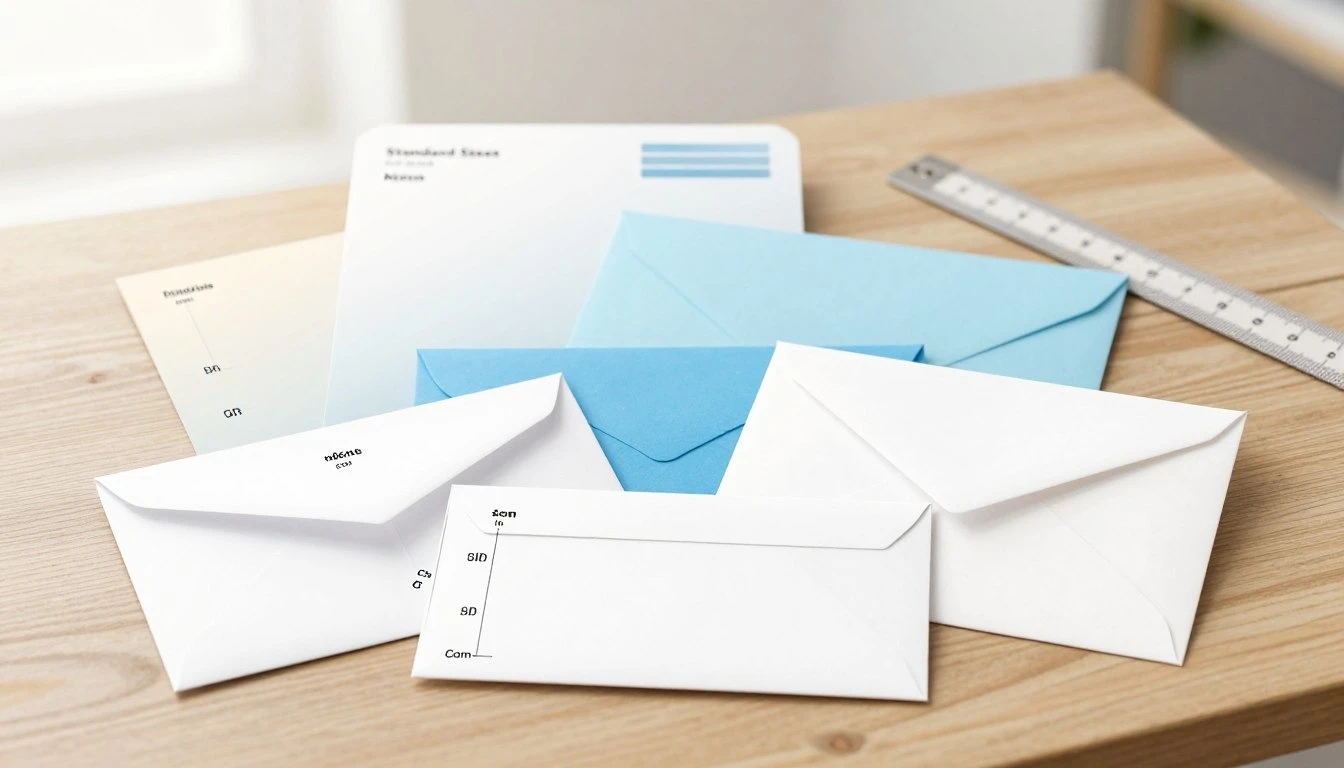
When you order envelopes online, you need to know some technical details. You must decide on the paper size for your envelopes. Most online printing services require digital files that meet specific standards for quality.
Digital printing specs are key for a successful order. Your design file should meet these important requirements:
- Resolution of 300 DPI minimum for sharp, professional output
- Color mode set to CMYK, not RGB (RGB is for screens only)
- Bleed area of 1/8 inch extending beyond the trim line
- Safe zone of 1/4 inch minimum margin around critical content
When designing your envelope, keep text and images away from edges. This safe zone prevents cutting off during trimming. Online printers offer templates to guide where your design should go.
Online envelope printing services offer different paper stocks and printing methods. Knowing your options helps you choose the best for your needs:
| Paper Stock | Weight | Best Use | Typical Finish |
|---|---|---|---|
| Standard White Wove | 24 lb | Budget-friendly mailings | Smooth |
| Premium Text | 70-80 lb | Professional business | Wove or laid |
| Cardstock | 110 lb | Special occasions | Glossy or matte |
| Colored Stock | 24-70 lb | Creative marketing | Various finishes |
There are two main printing methods online. Digital printing is best for orders under 500 units and offers quick service. Offset printing is for larger orders and is more cost-effective for bulk.
Turnaround times vary based on your choices. Digital printing takes 3 to 5 business days. Offset printing takes 7 to 10 business days. Rush options are available but cost more.
Always request a proof copy before finalizing your order. This ensures color accuracy and overall quality. Screen colors can differ from printed ones. A proof helps catch any issues before production starts.
Finishing options can enhance your envelopes. Most online printers offer gum, peel-and-seal strips, or remoistenable adhesive. Choose the best option for your needs.
Knowing digital printing specs and the right paper size ensures your order meets your expectations. Review all requirements before submitting your design files to your chosen online printer.
Conclusion
Choosing the right paper size for envelope printing is key to your mailing success. It’s all about matching your content size with the right envelope dimensions. Standard sizes like the #10 envelope are great for business letters and professional documents.
Announcement envelopes in A-series formats are perfect for personal invitations and greeting cards. Knowing these basic options helps you plan your printing better.
So, what paper size should you use for envelope printing? It depends on your content size, mailing purpose, and postal service rules. Business letters usually fit in a #10 envelope, which is 4.125 by 9.5 inches.
Personal invitations might need larger announcement sizes. You can find measurements in both inches and centimeters, which helps with planning in different regions. Online printing services need specific file formats and setup details for quality results.
Choosing the right envelope size saves you money and makes your mailings look professional. It also keeps your mail compliant with postal regulations, avoiding delivery delays. Getting the specs right the first time keeps your workflow efficient.
When starting your next envelope printing project, refer to the detailed measurements and guidelines from earlier sections. Standard sizes cover most business and personal needs at lower costs. Custom envelope options are available for special cases, but they cost more and often require larger orders.
Successful envelope printing starts with understanding your paper size options. Make smart choices based on your content, goals, and presentation needs. Now, you have the knowledge to confidently make your envelope printing decisions.

Leave a Reply