

Catalog Envelopes are big mailers for papers and print pieces that shouldn’t be folded. In U.S. offices, they’re a top pick for mailing documents that need to arrive flat and easy to read.
The main difference between catalog and booklet envelopes is how they open. For all catalog envelopes open on the short side, other booklet envelopes open on the long side. This small detail affects how fast you can stuff them, how they stack, and how well they protect what’s inside.
For sending contracts, proposals, and reports, the right envelope matters. It supports both how they look and how safe they are. It also impacts catalog envelope postage, as size, thickness, and paper weight matter for mailing rules.
This guide makes business mailing envelopes (U.S.) easy to understand. You’ll learn how to pick the right style, size, materials, closures, and printing options for what and how you send this.
Key Takeaways
- Catalog Envelopes are designed to keep important materials flat instead of folded.
- The catalog vs booklet envelope decision often starts with short-side versus long-side opening.
- Envelope design affects speed at the desk and consistency in mailroom workflows.
- Choosing the right mailing envelopes for documents helps reduce bends, scuffs, and edge damage.
- Catalog envelope postage can vary with size, thickness, and paper stock.
- Business mailing envelopes (U.S.) can be selected and customized to fit both protection and brand needs.
Understand about What is a Catalog Envelope?
Catalog envelopes are designed to keep papers flat and clean. They are great when a regular letter envelope is too small or flimsy. They ensure that documents arrive looking crisp, not creased.
Open-end design: flap on the short side for easy access
Catalog envelopes have an open-end design. The flap is on the short side, making it easy to slide in and pull out pages. This design helps speed up office mailings by making it simpler to handle documents.
Built for unfolded documents, brochures, magazines, and thick inserts
This design is perfect for items that shouldn’t be folded. It’s great for letter-size sheets, brochures, magazines, thin books, or multi-piece packets. Compared to booklet envelopes, the open-end design is more natural for flat, wide items.
| Item being mailed | Why it fits the open-end format | Mailing benefit |
| For unfolded 8.5″ x 11″ documents | Slides in flat through the short-side opening | Cleaner presentation for professional document mailing |
| With brochures and sales sheets | Reduces edge curl and corner wear | Helps printed pieces look polished on arrival |
| Get magazines or thin booklets | Handles thicker spines better than everyday envelopes | Supports a more secure professional document mailing |
| Multiple inserts (forms, letters, spec sheets) | Keeps mixed paper sizes aligned in one packet | Better control during office mailings and processing |
Common business uses: contracts, proposals, annual reports, and office mailings
Teams often use catalog envelopes for contracts, proposals, annual reports, and sales literature. The envelopes are sturdy, protecting the contents during shipping. For businesses sending valuable documents, these envelopes help maintain a professional image.
Catalog Envelopes
Catalog Envelopes are perfect for flat, important documents that need a clean look. They are easy to handle in busy offices. They also protect your mail well, even on long routes and when sorted a lot.
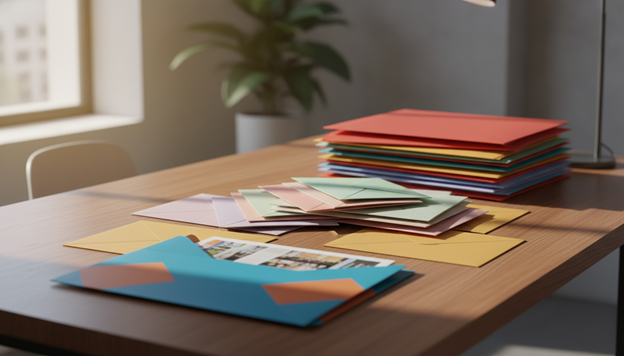
Why they’re considered “open end” (O.E.) envelopes
These envelopes are called open end envelopes, or O.E. for short. The seal flap is on the short side. This means the envelope opens along the top edge, not the long side.
This design keeps the wide face panel intact. It also makes it easy to slide in letter-size sheets, brochures, and thicker inserts straight.
When their short-side opening is an advantage in mailing workflows
The short opening makes the mailroom work faster when stacks need to stay straight. It lets teams insert pages without bending the long edge. This keeps papers square and easy to get out later.
- Faster staging: contents can be loaded and stacked neatly for batching and metering.
- Cleaner pull-out: recipients can remove documents without dragging corners across a long seam.
- Better control: the opening guides thick sets into place with less shifting.
How sturdy construction helps prevent bending and creasing in transit
Many heavy-duty catalog envelopes are made with thicker paper for extra stiffness. Some feel almost like light cardstock. This makes them better at protecting mail during transit.
Paper is common for office mail. But DuPont Tyvek, made from polyethylene fibers, adds extra strength against tears and moisture for tougher conditions.
| Build choice | And What it helps with | Best-fit mailing situations |
| Standard paper Catalog Envelopes | Balanced stiffness and print quality for clear addressing | Proposals, reports, and routine business packets |
| heavy-duty catalog envelopes in thicker stock | Extra rigidity for preventing bends and creases under pressure | Long routes, dense document sets, and high-speed processing |
| And Tyvek open end envelopes | High tear resistance and better moisture tolerance than paper | Field deliveries, mixed-weather handling, and repeat handling points |
Understanding about What is a Booklet Envelope?
Booklet envelopes keep printed pieces flat as they move. They’re used when a standard envelope is too tight. The flap opens like a book, making them easy to use.
Open-side design: flap on the long side with side seams
For envelopes open on the long side. They have side seams to keep their shape. This design supports clean edges, perfect for flat marketing pieces.
These envelopes also reduce corner dings. The long opening is more forgiving for heavier inserts.
Why booklet envelopes are easier to hand-stuff in higher quantities
The long opening makes manual stuffing easier. They load faster for events, client packets, or daily mail.
Open side envelopes work well with automatic insertion setups. A 10 booklet envelope is great for business mail that needs a clean fit.
Typical contents: brochures, pamphlets, booklets, and document packets
These envelopes are chosen for flat, presentable pieces. They’re practical for tidy bundles that handle well.
| Common contents | Why this format helps | Typical handling focus |
| Tri-fold brochures and sales sheets | Wide opening reduces snagging and edge curl | Fast hand-stuffing for campaign drops |
| Pamphlets and small booklets | Side seams support a flatter stack | Neat presentation at delivery |
| Reports and internal office sets | More room for thicker paper and inserts | Less time spent reshaping corners |
| Document packets with multiple pages | Long-side access makes alignment easier | Cleaner packing for repeat sends |
Booklet envelopes are great for flat, organized mailers. They’re easy to handle and support brochures, booklets, and document packets without forcing folds.
Catalog vs Booklet Envelope: The Core Functional Differences
Choosing between a catalog and booklet envelope depends on how the package opens and how it’s filled. It also depends on how well it protects flat paper. Getting the size right helps control weight and postage, which is important when your stack gets thick.
Opening orientation: open end vs open side
There are booklet envelopes open on the long side, while catalog envelopes open on the short side.
When comparing sizes, think about how the paper fits. Booklet envelopes are good for wide packets. Catalog envelopes are better for tall, flat inserts.
Stuffing and handling: manual insertion, access, and everyday office use
O.S. designs are quicker for hand-stuffing because their mouths are wider. This is why many offices use booklet styles for large mail runs.
Catalog styles are better for pulling pages out like a file. This is useful for envelopes for contracts that need to be reviewed and re-filed.
In a document mailing tutorial, try staging your packet first. Then, do a dry run. If corners catch or the stack bows, you’re either overstuffing or using the wrong size.
Mailing protection: reducing damage for large, unfolded paper and printed materials
Both formats protect items that shouldn’t be folded. But, sturdy catalog options are better for limiting bends and scuffs during transit. This is important for envelopes for magazines, where glossy covers show wear fast.
Paper quality also matters. Both types range from economy white wove to thicker, more durable stocks. These hold shape better in sorting equipment.
Postage is a practical consideration. Larger formats and thicker inserts can increase postage costs. Choosing the right size keeps protection strong without wasting money.
| Decision point | Booklet envelope (Open Side / O.S.) | Catalog envelope (Open End / O.E.) |
| Where it opens | Long side opening supports broad, easy access | Short side opening supports tall, file-like access |
| Best for hand-stuffing | Often faster for high-volume manual insertion | Works well when packets are rigid and aligned |
| Typical flat contents | Brochures, booklets, multi-page document packets | Unfolded sheets, thick inserts, formal packets |
| Protection focus in transit | Reduces folding by allowing flat placement; protection depends on stock | Commonly selected for added rigidity to reduce bends and creases |
| Common business fit | Good when speed matters for mixed document stacks | Strong choice for envelopes for contracts and other keep-flat records |
| Cost control lever | Right sizing helps avoid “air space” that adds bulk | Right sizing helps avoid extra ounces and higher postage tiers |
Catalog vs Booklet Envelope Size and Fit Guide
When checking if an envelope fits, think about two things. Is the paper flat or folded? Is it a single sheet or a bunch of pages? This makes choosing between catalog and booklet envelopes easier.
Common catalog envelope sizes match office paper sizes. This makes picking the right one quick. You avoid problems like jammed flaps and bent corners.
9×12 for letter-size sheets mailed flat
catalog envelopes 9×12 are perfect for sending 8.5 x 11 sheets flat. They keep documents looking crisp and sharp.
Insurance companies often use these envelopes for policy documents. They also work well for medium-sized magazines. This size reduces wear and tear during shipping.
6×9 for smaller inserts and folded pages
catalog envelopes 6×9 are great for smaller items like pamphlets and flyers. They’re good for compact content or when you want a lighter mail piece.
An 8.5 x 11 page can fit here if folded in half. But, if you need it flat, choose a larger size instead.
#10 booklet sizing as a quick office reference
A 10 booklet envelope is useful because “#10” is common in U.S. offices. The standard #10 business envelope is 4.125 x 9.5. It holds an 8.5 x 11 sheet tri-folded, ideal for letters.
If your 9 x 12 envelope feels too tight, go bigger. Many teams use 10 x 13 (#13 Booklet) for thicker stacks. This gives them room to breathe and reduces stress on the envelope.
| Mail piece goal | Best fit logic | Typical contents | Size callout |
| Keep 8.5 x 11 sheets flat | Choose a flat mailer with room for edges and easy sealing | Contracts, proposals, policy packets, medium magazines | catalog envelopes 9×12 |
| Send compact pieces or folded letter-size | Use a smaller flat envelope; fold once if starting from 8.5 x 11 | Pamphlets, booklets, small catalogs, flyers | catalog envelopes 6×9 |
| Use a familiar office baseline for folded letters | Tri-fold the sheet; good for thin documents and routine mail | Statements, letters, simple notices | 10 booklet envelope (4.125 x 9.5 reference) |
| Mail thicker flat stacks without strain | Size up when 9 x 12 feels snug due to bulk | Multi-page packets, heavier inserts, thicker document sets | 10 x 13 (#13 Booklet) upgrade path |
Catalog Envelopes Sizes, Materials, and Construction Options
Choosing the right catalog envelopes sizes is key. It depends on what you mail and how it moves. Sizes range from 2.5″ x 4.25″ for small items to 22″ x 27″ for big documents. The right size helps avoid damage and extra postage.
Material choice affects both protection and look. White wove envelopes are great for professional mail like proposals. Kraft envelopes are good for everyday use because they hide scuffs well.
Tyvek envelopes are tough for packages that get handled a lot. They’re made from DuPont fibers and are strong against tears and moisture. They’re also light and work well for long trips.
Color and finish are important for sorting and brand look. Suppliers offer white, brown kraft, and colors. This helps teams sort mail easily. Details like strong seams and a firm paper basis make packing easier.
| Option | Common size range | Best for | Its Strength and handling notes | Typical look |
| For White wove catalog envelopes | From 6″ x 9″ to 9″ x 12″ and larger | Contracts, proposals, statements, office mail | Smooth paper surface; choose heavier stock to reduce edge curl and bending | Get Bright white, clean finish |
| Kraft catalog envelopes | From small flats to large formats like 14.5″ x 19″ | General shipping, literature drops, internal distribution | Durable paper feel; scuffs blend in, and thicker kraft improves puncture resistance | Brown kraft, work-ready appearance |
| Tyvek catalog envelopes | Commonly used in mid to large sizes for document packs | High-handling mail, longer routes, moisture-prone deliveries | DuPont polyethylene fiber sheet; strong tear resistance with low weight and good flex | White, slightly textured, plastic-like feel |
| Therefore Heavy-duty mailing envelopes | Wide range, including oversized up to 22″ x 27″ | Magazines, catalogs, thick inserts, premium printed materials | Built with heavier paper or rugged synthetics; reinforced seams help prevent blowouts | Varies by stock: white, kraft, and select colors |
Closures, Security Features, and Mailing Durability
Choosing the right closure is key for speed, privacy, and avoiding damage. It also affects the cost of mailing when an envelope needs to be resealed or re-mailed.
Common closure types: remoistening gum, peel-and-seal, and clasp options
Remoistening gum is a classic choice. You wet the flap, press it down, and it dries to seal. It’s great for long trips and storage, but needs clean handling.
Peel-and-seal envelopes are faster. They’re perfect for sealing stacks quickly. Brands like Pres-Stik® and Kwik-Tak® make them easy to use and mess-free.
Clasp closure envelopes have a strong metal clasp for bulky inserts. They’re good for hand-delivery but not for automated processes after conversion.
Security and handling upgrades: stronger seals, tamper-resistance, and tear-resistance options
Tamper-resistant envelopes show signs of entry attempts. They’re great for keeping mail secure. Some have stronger adhesive or flap designs for extra protection.
Tear-resistant envelopes are for tough mail. They use rugged materials to prevent damage. This is important for mail with thick brochures or sharp corners.
Durability in transit: why heavier stocks and rugged materials matter for long-distance mailing
Heavier stocks protect against bends and drops. They keep large sheets flat, reducing the need for reprints.
And for durability also saves money. If an envelope fails, re-mailing can increase costs. This is true for larger or thicker pieces that need extra postage.
| Feature | Best for | Operational note | Cost/postage impact |
| Remoistening gum seal | Secure, long-term closure on stored or mailed packets | Needs moisture and firm pressure; works best with clean flaps | Can help prevent re-mails caused by weak seals |
| Peel-and-seal catalog envelopes | Fast sealing for daily outbound mail and print-room runs | Release liner speeds processing; consistent closure with less handling | Supports efficiency that can reduce waste and avoid repeat shipments |
| Clasp closure envelopes | Bulky inserts, internal routing, hand delivery, and file reuse | Metal clasp may interfere with automation after conversion | Useful for reuse, but may add handling steps for mailed pieces |
| Tamper-resistant envelopes | Confidential mailings and controlled distribution | Designed to show entry attempts and discourage casual opening | May cost more per unit, but helps limit loss and re-mailing |
| Tear-resistant envelopes | Long routes, heavy contents, and high-friction handling | Reinforced or synthetic builds resist splits and corner damage | Can reduce damage-related re-mails that increase catalog envelope postage |
Custom Catalog Envelopes and Printed Envelopes for Branding

Branding starts before the mail is opened. Custom catalog envelopes make your message look planned, not rushed. They also help with sorting, scanning, and quick handling in busy offices.
What you can customize: logo, return address, and campaign designs
Most printed envelopes can carry a crisp logo, a clean return address, and campaign art. Color choices matter, but so does spacing. Postal marks and barcodes need room.
For branded business envelopes, simple often wins. One strong mark, readable type, and a clear callout line for the department or mail stop are key. This keeps your identity consistent across proposals, annual reports, and document packs.
When printed envelopes improve recognition and professionalism in business mail
Printed envelopes help recipients spot your organization fast, even in a full mailbox. This recognition can reduce hesitation, making it easier to open formal, time-sensitive, or compliance-driven mail.
For branded business envelopes used with contracts, reports, and policy updates, print quality signals care. Smudged ink, weak contrast, and cluttered designs can undercut trust before the first page is read.
Window and no-window considerations for statements, policies, and document packs
Window catalog envelopes work well when the recipient address is printed on the first page inside. Teams that send statements, policy mailings, and recurring document sets often prefer this setup to speed up processing and reduce addressing errors.
No-window catalog envelopes are a better fit when you need full privacy on the outer face or when inserts shift in transit. They also make sense for thicker packets where alignment can be hard to control.
Some print shops special-order digital-friendly window films for high-heat devices, including Xerox production printers, to prevent warping. That detail matters when you’re running large batches of window catalog envelopes on tight deadlines.
| Mailing need | Best envelope choice | Why it helps | Practical print note |
| Monthly statements with address block on page 1 | window catalog envelopes | Faster setup; fewer labels; consistent placement for scanning | Keep the address area clear of heavy graphics to protect legibility |
| Policy packets with sensitive topics | no-window catalog envelopes | More discretion; fewer visibility risks during handling | Use a strong, simple layout so postal marks don’t crowd key branding |
| Campaign outreach with brand recall goals | custom catalog envelopes | Supports consistent look across mailers and printed inserts | Match ink colors to your core brand palette for repeatable results |
| Everyday business documents sent at scale | printed envelopes | Improves recognition and keeps mailroom workflows organized | Choose readable fonts and leave margins for automation codes |
| Client-facing packets where presentation is part of the pitch | branded business envelopes | Creates a professional first impression before opening | Consistent placement of logo and return address builds familiarity |
Catalog Envelopes Wholesale Buying Tips for U.S. Businesses
For steady outbound mail, smart purchasing comes down to repeatable choices. Many teams start with catalog envelopes wholesale to keep ordering simple across departments and locations.
When bulk purchasing lowers unit costs for recurring mailings
If you send contracts, proposals, policy packets, or annual reports every week, bulk catalog envelopes can bring the per-piece price down fast. It also reduces last-minute rush orders that inflate freight and slow fulfillment.
Stocking core business mailing supplies helps mailrooms stay consistent, even when several people handle packing. Fewer “out of stock” surprises also mean fewer substitutions that can trigger returns or damaged documents.
How to standardize sizes to simplify ordering and reduce custom minimums
Using standard envelope sizes is one of the easiest ways to control spend. Custom dimensions often come with higher minimums, longer lead times, and a higher unit price, even before printing is added.
Keep a short list of approved sizes and paper weights, then match documents to the envelope instead of the other way around. This approach supports cost-effective envelope ordering and makes it easier to compare quotes.
| Mailing need | Practical size approach | Why it helps procurement | Cost and postage watch-outs |
| Unfolded letter-size sheets and thick packets | Choose a common catalog format aligned with standard envelope sizes | Improves availability and reduces the chance of custom minimums | Overstuffing can raise postage and stress seams in transit |
| Smaller inserts, folded pages, and short reports | Standardize a smaller everyday size for routine use | Supports faster reorders and steadier inventory counts | Too large an envelope can add unnecessary material cost and weight |
| Premium presentations and long-distance shipping | Reserve upgraded materials and closures for select runs | Keeps everyday SKUs simple while protecting high-value mail | Heavier stock and added features may push mail into a higher rate |
Choosing the right mix: everyday mailers vs specialty runs for campaigns and reports
A balanced plan keeps routine supplies separate from high-visibility needs. Maintain everyday inventory in a few common sizes, then schedule specialty runs for campaigns, annual reports, and sales literature.
Specialty mailers may justify heavier stock, Tyvek, stronger seals, windows, or printing, but only when the piece truly needs it. By matching fit and features to the job, business mailing supplies stay lean and spend stays predictable through cost-effective envelope ordering.
Conclusion
Choosing between Catalog Envelopes and booklet styles depends on your workflow and how you protect your documents. Open-end envelopes are great for quick access, while open-side ones are better for stuffing in bulk. Consider how your team inserts pages and how the recipient will take them out without damage.
It’s also key to think about the size of your envelopes. A 9×12 envelope is perfect for keeping 8.5×11 sheets flat, ideal for presentations and reports. A 6×9 envelope is good for smaller inserts or folded letter-size pages. And, a 10×13 booklet-style envelope can prevent jams when your packet gets thick.
In U.S. mailrooms, the right materials and seals can save time and money. Tyvek adds protection against tears and moisture. Choose your closure wisely: remoistened gum for standard runs, Kwik-Tak® for speed, or clasp closures for repeated access. These choices help Catalog Envelopes handle long routes and busy handling well.
Branding is the last but not least important aspect. Custom catalog envelopes with printed return info and clear designs look more official. Window or no-window layouts can also make addressing easier. Buying catalog envelopes in bulk can keep costs down and ensure consistency across departments.

Leave a Reply