
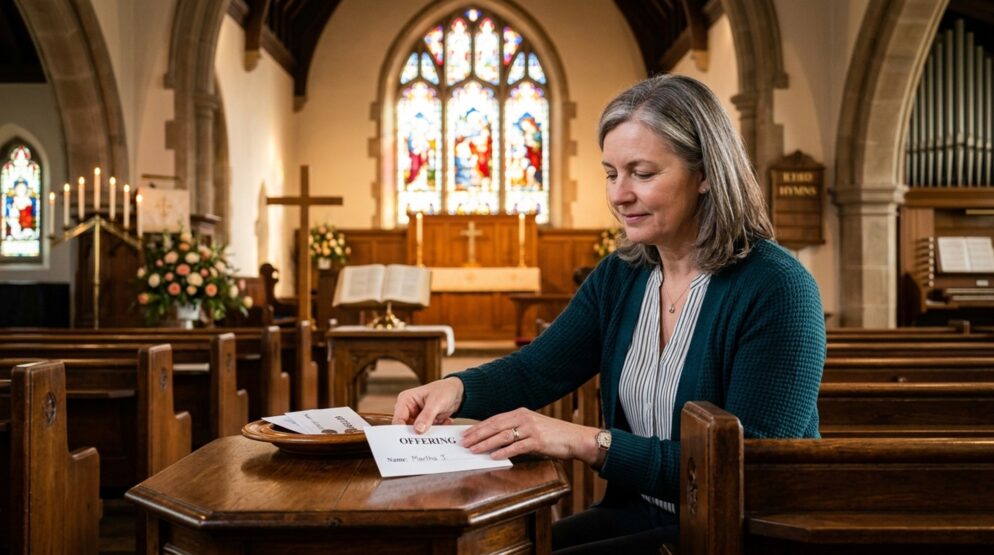
Churches are use offering envelopes to organize contributions, connect gifts with donor records, and carry instructions about intended uses. They also support regular church giving by providing a reminder donors can fit into their budgets.
For the person placing a gift in the collection, the envelope keeps money and instructions together. For the volunteer recording it, those details reduce guesswork. Stewardship means responsibly managing money and other resources entrusted to a person or organization.
Financial stewardship includes treating each gift with care, regardless of its size. The envelope serves as an administrative aid, not a measure of faith or generosity. Its value becomes clear when the church must turn a collection into accurate records.
Key Takeaways
- Connect gifts with the right donor.
- Keep fund instructions with contributions.
- Support giving without applying pressure.
- Protect details through sound handling.
- Keep paper and digital records consistent.
Why Do Churches Use Offering Envelopes Instead of Loose Cash?
Two donors place identical $20 bills in a collection plate, but one intends to support missions. Without written instructions, the church cannot tell which gift belongs to that fund. An envelope keeps each payment with the details needed to record it.
Loose cash without identifying information cannot reliably connect a gift to a particular donor. A bill alone carries no name, envelope number, or designated fund. Legible donor information gives the church a way to make that connection.
The practical benefits of organized donations come from four functions:
- Connecting a gift to a donor through a name or envelope number.
- Carrying instructions for the donor’s intended fund.
- Containing cash or checks during collection.
- Reducing casual visibility of the amount during worship.
These functions explain why offering envelopes for churches remain useful even when donors give the same amount. The amount identifies neither the person nor the purpose. Written details keep those separate facts attached to the payment.
A sealed envelope conceals its contents from casual observers during the offertory, the collection during worship. It does not make a named gift anonymous to people who process contributions. Donors who want anonymity should understand that difference before adding their names.
An unmarked envelope can contain cash securely without creating a usable donor record. The church can include that money in its collection total. It cannot safely assign the gift to someone based on where that person sat.
Good collection handling preserves the connection between a gift and its instructions. An envelope supplies that connection only when its details are clear enough to use. Those details must then become a reliable entry in the church’s giving records.
How Envelope Details Become Giving Records and Tax Acknowledgments
A clear envelope number can distinguish two donors with the same last name. The church matches that number to its donor register before posting the gift. Accurate matching turns the information on paper into a useful contribution entry.
Numbered Church Offering Envelopes and Donor Records
Numbered church offering envelopes work through a maintained register linking each envelope number to a donor record. The number provides donor identification without requiring a full name on every gift. It works only when staff keep the matching register accurate.
An outdated household assignment can send a new gift to the wrong record. For example, reassigning a number without updating the register can credit its former user. Staff should resolve conflicting names and numbers before treating the match as settled.
| Field | Illustrative entry | Administrative use |
| Donor identifier | household 104 | match the donor register |
| Gift date | date written by donor | compare with collection records |
| Amount | amount written by donor | compare with counted contents |
| Fund | missions | route the recorded gift |
The counted contents, not an unchecked written amount, determine the posted contribution. If an envelope says $60 but contains $40, staff must address the difference. Simply copying the larger figure creates an inaccurate record.
Dates and fund choices also need careful entry. A donor’s written date can help explain a gift received during a different collection period. Clear fund instructions help staff post the gift to the intended accepted fund.
Written Acknowledgments for Tax Records
Giving statements are church-issued records of contributions; donor-created envelopes do not replace the required tax documentation. For federal tax substantiation, monetary gifts of any amount generally require a bank record or written communication from the charity. An envelope alone does not establish tax deductibility.
For a U.S. charitable contribution of $250 or more, the donor generally needs a contemporaneous written acknowledgment from the charity. That means obtaining it by the applicable IRS deadline, not simply requesting it after a tax review begins. The acknowledgment must address whether the charity provided goods or services in exchange.
When the charity provides goods or services, the acknowledgment generally describes them and gives a good-faith estimate of their value. Special wording applies when the only benefit consists of intangible religious benefits. Donors should check IRS guidance or their tax adviser for their situation.
Accurate giving statements start with accurate entries, not with the appearance of an envelope. A dependable record also makes recurring envelopes useful as reminders rather than paperwork donors must later correct.
Regular Giving Without Pressure or Attendance Assumptions
A recurring envelope can remind a household to budget, but a missing envelope does not prove disengagement. Consistent giving works best as a chosen habit, not a test of belonging. Income changes, anonymous gifts, and other giving channels can all explain gaps.
A tithe traditionally means one-tenth, while an offering is a broader voluntary gift. Christian traditions differ on whether and how tithing obligations apply. Churches should explain their own teachings about tithes and offerings without presenting them as universal.
Recurring reminders can help donors plan voluntary contributions alongside rent, food, and other household needs. A prepared envelope offers a prompt, not proof that a particular amount is affordable. The donor’s circumstances still matter.
- Choose a manageable giving schedule that fits your household budget.
- Review that schedule when your income or essential expenses change.
- Ask about a noncash option when you need another way to give.
A workable schedule leaves room for changes rather than treating every missed contribution as a debt. A donor with uneven income may need a different pattern from someone receiving a steady paycheck. Neither pattern alone measures commitment to the congregation.
Some congregations may consult contribution activity when assessing parish participation. An envelope delivered by another person cannot verify physical attendance. A gift made through another channel cannot establish that someone attended a specific service either.
A regular attendee may give anonymously or lack money to contribute. Treating an empty giving record as an attendance record would overlook both situations. Questions about sacramental eligibility or tuition policies belong with the individual parish.
Churches can explain giving practices clearly without using envelopes to monitor worshipers. That same care should guide the format they offer: the envelope should fit the congregation’s actual routine.
Choosing Boxed, Weekly, or Blank Envelopes
A household seeking a prepared sequence needs a different format from a visitor making one gift. Boxed sets suit planned use, while blank envelopes offer flexibility. The best choice follows how donors actually give, not how often the church expects them to contribute.
Envelope formats should also fit the work volunteers perform after collection. Clear printing, enough writing space, and a reliable closure matter more than decorative detail. A format that is hard to read creates extra work at every collection.
Boxed Church Offering Envelopes for Weekly Giving
Boxed church offering envelopes give donors a prepared sequence they can keep at home. Sets may organize envelopes by scheduled giving dates. That arrangement suits households that prefer to prepare gifts before arriving at worship.
Weekly church offering envelopes can carry dates or sequence markers to guide use. They work best when those markers match the congregation’s collection routine. A confusing schedule can leave donors unsure which envelope to choose.
Dated sets provide a clear prompt for people who follow a steady schedule. Undated options give more freedom to donors with irregular work, travel, or attendance patterns. Neither format should imply that an unused envelope represents an unpaid bill.
A full dated set may create waste for someone who mostly gives online or attends seasonally. Churches can ask donors whether they want a full set before distributing one. Matching supply to actual use avoids leaving boxes untouched.
Blank Church Offering Envelopes for Visitors and Occasional Gifts
Blank church offering envelopes suit visitors and occasional donors because they do not require an assigned set. Donors or staff must supply the identifying details and fund instructions. Clear instructions nearby help people understand what to write.
A visitor should not need to guess whether a name or envelope number is required. Instructions can explain how someone without an assigned number should complete the envelope. They can also explain how to indicate an intended fund without assuming familiarity with church terms.
Check whether the envelope leaves enough room for handwriting that staff can read. The closure should keep the contents together through normal collection handling. The size should also fit the church’s collection containers and processing space.
A church may keep blank envelopes available while offering boxed sets only to donors who want them. That approach supports different routines without making one format the standard for belonging. Whatever the choice, sensible fields and clear instructions make the envelope usable.
Preparing Clear Envelopes and Filling Them Out Correctly
A $60 gift split between $40 for the general fund and $20 for missions needs both amounts written clearly. A total alone does not explain the donor’s intended split. Clear envelope instructions prevent that uncertainty before the gift enters the collection.
Custom Tithes and Offering Envelopes With Useful Fields
Custom tithes and offering envelopes should put useful fields ahead of decorative content. Give priority to a readable name or number, gift date, amount, and approved fund choices. Leave enough space for donors to complete each field without crowding their handwriting.
Designated funds identify intended uses, such as missions or a building fund. A donor’s requested use may depend on the church’s accepted funds and gift policies. Printing approved choices helps donors understand which purposes the church can accept.
To complete an envelope, write your name or envelope number and the gift date. Enter the amount, then mark the intended fund and any split. Enclose the gift and seal the envelope after checking that the written total matches its contents.
For the $60 example, write $40 beside the general fund and $20 beside missions. Marking both funds without amounts leaves the split unclear. Staff should not assume that two marked choices mean equal shares.
A nonexistent or closed fund also needs clarification. Churches should handle unclear designations through an established gift-acceptance process rather than guessing. Resolving the request protects both the donor’s intent and the church’s ability to use the gift properly.
Free Templates for Church Offering Envelopes
Free templates for church offering envelopes need a test print before anyone produces a full batch. Check readable type, fold placement, writing space, and fit. A layout that looks clear on a screen may leave a field across a fold.
Fold and close the test copy as a donor would. Make sure the closure does not cover the amount or fund instructions. Try filling it out by hand to see whether the spaces work in practice.
Once the fields are complete and the gift is enclosed, the envelope is ready for the church’s receiving and recording process.
Handling Offerings With Privacy and Financial Controls
An envelope cannot replace a controlled counting process. Authorized counters must open envelopes to verify and record their contents. Church financial controls make those details useful by connecting the collection, giving records, and bank deposit.
Counting and Reconciling Contributions
Contribution reconciliation compares counted receipts, recorded contributions, and deposit totals. Using at least two unrelated people for counting is a common church financial-control practice. The process should leave a clear record of amounts and any differences.
- Receive the collection together, keeping gifts and their envelope instructions connected.
- Count the contents and compare each gift with its written amount.
- Document discrepancies and fund allocations for follow-up and entry.
- Prepare a deposit record that matches the money counted.
- Reconcile the deposit with contribution entries and resolve differences.
A matched total is not the only goal. Staff must also check that gifts reached the correct donor records and designated funds. Two entries can offset each other while still crediting the wrong people.
Where staffing permits, separate receiving, recording, and reconciliation duties. That division gives another person a chance to notice mistakes. It also reduces reliance on one person’s memory of what happened.
A small congregation may lack enough volunteers to separate every task. An independent review can strengthen oversight when the same person handles several duties. Trust in a volunteer should not replace a review of the records.
Limiting Access to Donor Information
Donor confidentiality requires restricted access to the donor register and secure storage for paper and digital records. Envelopes shield amounts from casual observers, not from authorized counters. A sealed envelope provides limited privacy during collection, not secrecy throughout processing.
Give volunteers access only to the information their assigned work requires. Keep contribution details out of casual conversations and public work areas. Staff should also know where to place records when processing pauses.
Secure handling continues after the totals match. The church then needs a clear decision about which paper and digital records to keep after reconciliation.
Keeping and Disposing of Offering Envelopes
A documented retention policy, not a fixed envelope-disposal date, should guide what a church keeps. No single nationwide envelope-specific period fits every church. The policy must account for the records’ purpose and any duties that require continued storage.
Original envelopes, contribution ledgers, acknowledgment copies, and deposit documentation serve different roles. They should not receive one automatic destruction date merely because they concern the same collection. A ledger may preserve entries without preserving every instruction written on an envelope.
About seven years is a common planning benchmark for supporting financial records. It is not a universal legal retention period for original envelopes. Professional advice and organizational requirements can call for a different schedule.
Ask the church accountant or legal adviser to approve a written church record retention schedule. It should fit state, denominational, audit, and insurer requirements. Unresolved disputes, audits, and legal holds can require longer retention than the ordinary schedule allows.
Complete, legible digital copies may be appropriate under an approved records policy. Staff need a reliable index to retrieve the right contribution documentation. They also need backups that preserve access if a device fails.
Scanning alone does not create a useful archive. A folder of unreadable or unsearchable files can destroy the practical value of retained information. Test whether staff can find and open the copies before approving paper destruction.
Use a firm disposal gate: reconcile the period, resolve discrepancies, and confirm required copies are readable and recoverable. Check for holds before shredding approved paper. Secure disposal should prevent discarded donor details from returning to public view.
Record the disposal approval so staff can explain what happened to the paper. The remaining records must still work alongside contributions received through other channels.
Combining Paper Envelopes With Digital Giving
A donor makes one online gift, then places a paper note about it in the collection. Recording both as payments would double the contribution. The note and the payment transaction represent one gift, not two.
Hybrid church giving works when each channel feeds a consistent set of giving records. Staff need to distinguish payment evidence from a message about a payment. The main check changes with the way the gift arrives.
| Giving method | Donor identification | Payment evidence | Main check |
| Cash in a completed envelope | Written name or envelope number | Counted cash and collection record | Match contents to entry |
| Check in a completed envelope | Envelope details and check information | Check and deposit record | Reconcile payer and donor |
| Online gift | Account or transaction donor details | Payment transaction record | Exclude duplicate manual entry |
| Unidentified loose cash | No reliable individual identifier | Collection total and deposit record | Record without inventing a donor |
An online donor may use a participation note during worship. The note must clearly state that it refers to an online gift rather than a new payment. Staff should not assign a second amount merely because the note appears in the collection.
Digital giving can also create duplicate contribution entries when staff manually enter a transaction already added to giving records. Check the transaction record before creating another entry. A matching amount alone does not prove that two entries describe different gifts.
For checks, compare the payer information with the donor details rather than assuming they always match. Resolve unclear differences before assigning the gift. For unidentified cash, record the collection without inventing a donor identity.
Keep a paper option for donors who prefer it or lack digital access. No donor should need an online account simply to use the church’s normal giving process. Choose channels that preserve accurate records while keeping giving accessible.
Conclusion
A useful envelope system gives donors clear instructions and administrators accurate information. It should make contributions easier to identify without making people feel monitored or pressured. Responsible stewardship includes respecting both the gift and the person making it.
Keep envelopes as a practical tool, and make accessible giving the standard across the congregation. Clear records should support participation rather than become a test of commitment. For a concrete next step, place a current envelope beside the church’s contribution-entry screen. Check whether donor identification, amount, and fund instructions match the fields staff actually use, then correct any gap between envelope and record.
FAQ
How long should a church keep offering envelopes?
No universal envelope-specific period applies; about seven years is a common planning benchmark for supporting financial records. A church needs an approved policy before destroying original paper. Staff should confirm that required copies remain readable and recoverable, then check for unresolved disputes, audits, or legal holds that require longer storage.
Is it better to give tithes or offerings?
Neither label makes a gift more useful for administrative purposes; clear donor details and fund instructions matter for recording it. A tithe traditionally means one-tenth, while an offering is a broader voluntary gift. Religious expectations vary by tradition, so the spiritual meaning depends on the church’s teaching rather than the envelope’s label.
What is the purpose of an offertory envelope?
An offertory envelope carries a contribution together with donor details and intended fund instructions during the worship collection. It helps keep those details attached to the payment until staff record the gift. An unmarked envelope can hold cash, but its presence alone cannot establish who gave it or which fund they intended.
How much money should you give for an offering at church?
No universal required offering amount applies; choose an amount that fits your circumstances and religious tradition. Consider essential household needs and changes in income when deciding what you can give. Voluntary offerings differ from teachings about a 10% tithe, and churches vary in how they understand and apply those teachings.
What is the difference between offering and offertory?
An offering is the gift, while the offertory is the part of worship associated with presenting or collecting gifts. Liturgical details vary by church, so the collection may take different forms. Writing “offering” on an envelope describes the contribution; calling it an “offertory envelope” connects its use to that worship practice.
Why do we give Offertory in church?
Financial gifts during the offertory support the church’s ministry and practical needs and can express worship or gratitude. The religious explanation depends on the denomination and its teaching about giving. The gift and the collection are distinct: donors make offerings, while the offertory provides a place within worship to present or collect them.
Is it a sin if you do not tithe?
Christian traditions disagree about whether a binding 10% requirement applies, so no single answer represents every church. Inability to give should not become an automatic judgment about a person’s faith. A trusted pastor can discuss personal circumstances and explain the tradition’s teaching, including how it understands financial hardship and other responsibilities.

Leave a Reply